FIRE Magazine
Blue Sky Offices Shoreham
25 Cecil Pashley Way
Shoreham-by-Sea
West Sussex
BN43 5FF

Fire safety in the UK has been shaped by difficult historical lessons learned from serious incidents. This article examines key fire events that triggered lasting changes in legislation, guidance and practice, helping to define modern fire safety. By understanding how these moments influenced pollicy and culture, we can better navigate today’s fire safety responsibilities.
More than eight years have passed since our most recent serious fire incident; the Grenfell Tower disaster. Yet the cast has not set on what seems to be the ever-evolving fire safety landscape left in its wake. For this reason I have selected the following 11 incidents in UK history, based on their impact on fire safety.
The selection process began with online research. This led to numerous articles relating to high fire fatality incidents; background information was then gathered on the 15 most costly fires in UK history. But the results were unexpected; the highest fatality fires did not necessarily lead to the most impactful changes, and this presented the first challenge in data development – where to start?
The answer became clearer when reviewing fire safety publications. Todd (2008, p.323) recognised ‘the very earliest days of fire safety legislation’ and went on to describe the 1189 decree: which prescribed that City of London houses were to be built of stone, thatched roofs were to no longer be permissible, and party walls were required to be a minimum thickness and height. Armed with a commencement date, the next phase of data development began – what to include (and therefore exclude).
Filtering fire incidents to determine which should be selected and consequently which would be excluded proved to be the most challenging phase of the selection process. Successful fire incidents established a connection to fire safety progress. Whereas such a connection could not be found for unsuccessful fire incidents. Take, for instance, The Great Fire of Gateshead in 1854, where a factory fire led to 53 fatalities [Handyside, R]. While information on the fire incident was available, there was insufficient evidence to demonstrate fire safety progress post incident, hence it has been excluded.
Each serious fire incident has an introductory paragraph designed to provide context on what happened and why. This is followed by a paragraph which focuses on an impactful change category.
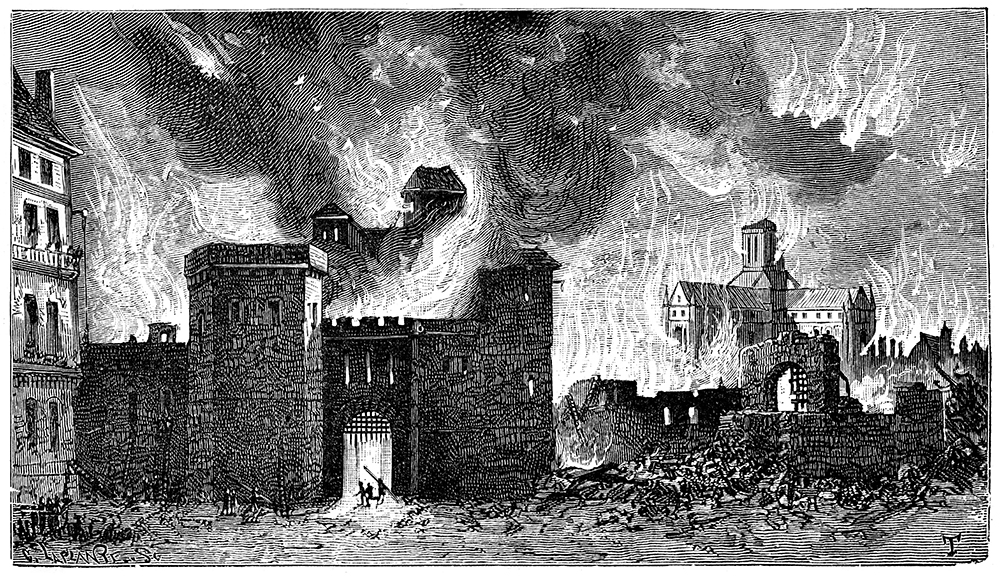
The Great Fire of Southwark is the lesser known and original Great Fire of London. The fire began on July 10, 1212, south of the river Thames in Southwark. However, it reached London Bridge quickly, and subsequently spread north of the river, resulting in a catastrophe across the city. While the root cause of the fire is not confirmed, historical accounts suggest it originated in either a bakery or a wealthy residents home. The death toll is also uncertain; Stow (1603) indicates the fatalities were in excess of 3,000, but the population of London at the time was no more than 50,000, leaving questions on the credibility of Stow’s calculation.
Cultural changes followed – the substantial post-fire reconstruction project was an early indication of behavioural improvement. Construction materials were selected for their fire-resistant performance, with stone chosen over wood, reducing potential fire spread between some properties. But short supply and increased costs stifled such progress – it would take another 400 years before systematic fire containment between properties was enhanced throughout London. [Fire Industry Association, 2024a].
The infamous Great Fire of London is more commonly known than its predecessor, The Great Fire of Southwark. While this proves ironic when comparing fatalities, it does not when comparing impact. The fire began late Sunday, September 2, 1666, north of the river Thames on Pudding Lane, reaching the river via Fish Hill, and then spreading rapidly east due to strong winds. The outcome was widespread destruction, more than 13,000 houses were lost, 87 parish churches ruined, and landmarks including the Royal Exchange, Guildhall, and St Paul’s Cathedral were destroyed. The estimated cost of the fire was £10 million, while London’s annual income was only £12,000 at the time [London Fire Brigade. (n.d.-a)]. It is widely known that the fire started at a baker’s shop, which belonged to Thomas Farynor (Farriner). Remarkably, only six people died, yet four fifths of London was gone forever [Johnson, B].
Legal changes followed – they began with The Rebuilding of London Acts of 1667 and 1670; that new buildings were to be built of brick or stone, restricting the use of flammable materials, banning ‘jettying’ upper stories and protruding signs, and mandating party walls [Bransgrove, J]. The Rebuilding Acts were later consolidated, among others to form the Fires Prevention (Metropolis) Act 1774, standardising the construction of buildings across London (and influencing other major cities). The London Borough of Bromley recognised that regional approaches continued until the Public Health Act 1875, which established a nationalised approach and subsequently led to The Building Regulations 1965.
Cultural changes also followed – Todd (2008, p.336) recognises how The Great Fire of London ‘drew attention to the absence of any coordinated method of fighting fires and the need for some form of insurance’. The first fire insurance company, the Fire Office, was established, relatively shortly after in 1680, by Nicholas Barbon, confirming Todd’s statement.
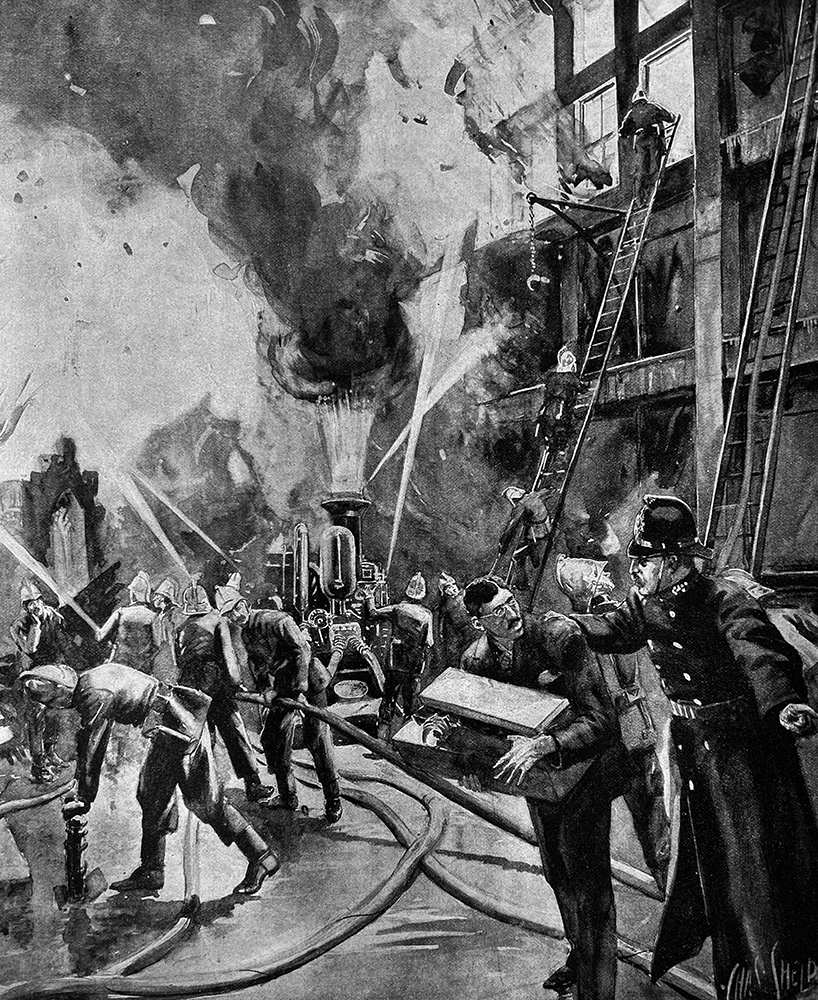
The Victoria Hall disaster is an anomaly – the incident was not caused by a fire – yet the impact on fire safety development proved significant, presenting a different perspective for how a serious fire incident could be identified. The incident occurred on Saturday, June 16, 1883, at Victoria Hall, Sunderland. The Fays, a pair of travelling entertainers, used the venue to perform for children, and at 3pm, approximately 2,000 were in attendance. The tragedy began as the performance ended; an announcement that prizes were to be handed out at the entrance to the venue triggered a stampede. The entrance doors were inward opening and bolted leaving only a 50cm gap for the children to leave. In little time someone became trapped, leaving those stuck behind the doors to be fatally crushed. The bodies piled up 20 deep and 183 children, all aged between three and 14-years old, died from asphyxiation. [Mingren, 2019]
Legal changes followed and Sunderland City Council believe the incident enacted a legal change, stating ‘as a direct result of the disaster, Parliament issued laws that required all places of public entertainment to have a sufficient number of exits, and that all exit doors must open outwards and be easy to open.’ Such requirements have survived for more than 140 years and remain evident in The Regulatory Reform (Fire Safety) Order 2005 (FSO). Yet a much earlier opportunity was missed to initiate these impactful legal changes; The Burwell Barn fire of 1727 resulted in 78 fatalities, most of whom were trapped behind a nailed-up door! [Walton, 2018]
Cultural changes also followed – the daughter of a man called Robert Alexander Briggs was quoted, ‘As a direct consequence of the disaster, my father, Robert Alexander Briggs, invented the bolt which has been in compulsory use in public buildings for many years now.’ Though Robert was 15 in 1883, he did go on to design the panic bar mechanism; his patent application was accepted on August 13, 1892 [Briggs, 1891]. Panic bars, more commonly referred to as push bars today, have become synonymous with final exits; this shows the value of Robert Alexander Briggs’ invention.
The fire occurred on the evening of Monday September 5, 1887, while an audience of more than 800 people were watching the opening night of Romany Rye. During the fourth act of the production, the fire began on stage, toxic smoke soon filled the auditorium and the theatre was ablaze. The fire originated in the area above the stage where the sets were operated, called the ‘fly system’; it was naked gas jets that ignited the stage curtain. The death toll was substantial and remains one of the highest in UK history. Most of the 186 fatalities were on the first-floor gallery and faced only one way out, which was partially obstructed by the ticket office. [BBC, 2003]
Cultural improvements followed – the fire is referenced within the Manual of Safety Requirements in Theatres and Other Places of Public Entertainment, UK, Home Office, (1934); demonstrating the event’s significance. The manual was intended to provide a model code for local authorities to apply and should not be mistaken as legislation. Interestingly, the manual also describes the Edinburgh Palace Theatre fire, 1911, where the audience evacuated within two and a half minutes to the sound of a band playing the national anthem; this has become synonymous with fire drills.
The fire occurred on Thursday, February 23, 1956, while employees were working at the spinning mill. It began on the bottom floor, rapidly spreading upwards until all three storeys were ablaze, leaving the building engulfed in 18m flames. Ignition was caused by a blow torch lighting a rope, while hot water pipes were being installed. The inquest identified the building had no early warning and insufficient means of escape, contributing to the death of eight mill workers. [Fire Brigades Union. (n.d. -a)]
Legal changes followed – according to The Fire Protection Association (2021), the incident influenced legal change, stating ‘Following a fire at Eastwood Mills in Keighley in February 1956, fire brigades were given the power to inspect factories for fire safety.’ The Factories Act 1959 followed the fire; fire authorities were permitted to examine the means of escape in case of fire, and various general fire precautions, as they are often referred to today, were extended.
Earlier opportunities for change seemingly went unnoticed. The Booth’s Clothing Factory fire of 1941 resulted in 49 fatalities; the factory was constructed mainly of timber and the means of escape arrangements were insufficient [Fire Industry Association, 2024b]. Furthermore, the Factory Act was from the early 1800s, during the industrial revolution. Yet it was not until early in the 1900s that fire safety was introduced, while more developments led up to 1956. The Eastwood Mills fire revealed their weaknesses and prompted additional change to the existing legislation [Wallenfeldt, J]. In the years that followed, the Factories Act 1961 was introduced and similar principles would be adopted, including further ‘premises type’ legislation.
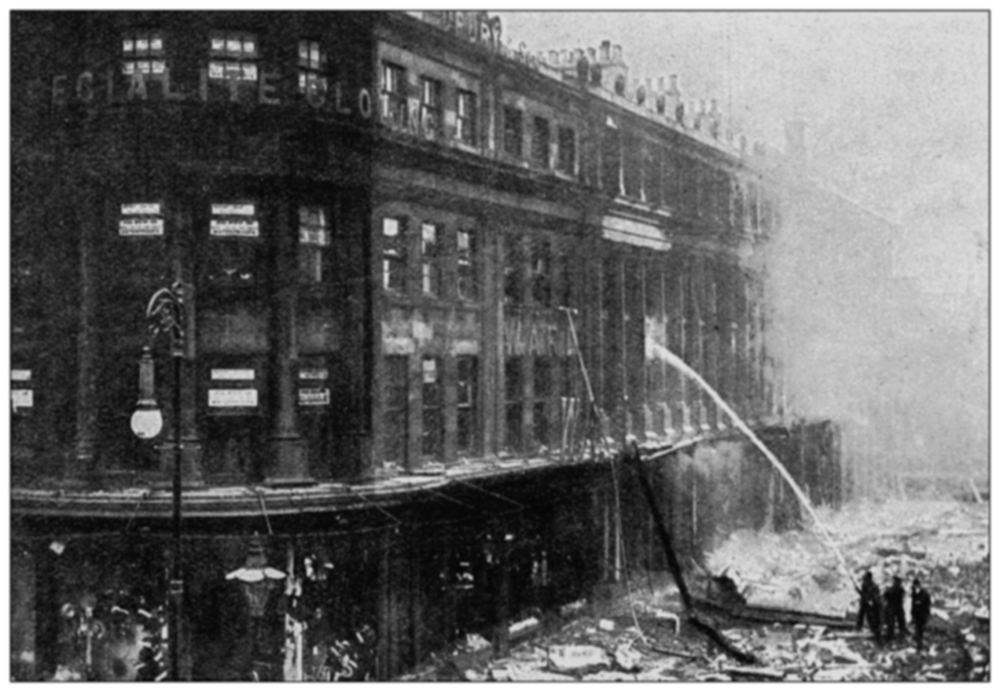
The fire occurred mid-afternoon on Wednesday, June 22, 1960, while hundreds of staff and customers were in the store. The incident started on the third floor and early attempts to tackle the fire with extinguishers failed. The upper section of the building was ablaze by the time the fire service appeared. Ignition was caused by arcing, across a protected steel electricity cable. Reports identified that fire doors were wedged open, and the store’s emergency response was poor, with unsuccessful fire-fighting attempts taking precedence over evacuating, raising the alarm, or contacting the service; fatefully 11 people died. [Inside Out North West, 2010]
Legal changes followed – the FBU (n.d. -b) identifies, ‘significant changes to fire safety regulations resulted from the fire. The government brought in the Offices, Shops and Railway Premises Act 1963, intended to extend workplace health and safety outlined in the Factories Act. Among its many provisions was to give fire brigades powers to inspect fire safety at offices, high street stores and railways.’. The Offices, Shops and Railway Premises Act gave fire authorities the power to examine premises with public access, and fire precautions were expanded yet again. Though ‘premises type’ legislation would soon give way to a new ‘fire specific’ approach.
The fire occurred about 11pm on Monday, May 1, 1961, while customers and staff occupied the night club on the top floor. It was discovered in the furniture workshop below the club and spread quickly, compromising the primary staircase, which served the upper floors. The inquest could not prove a cause, although they suspected ignition was deliberate. Sadly, 19 people were killed; 14 were trapped within the club and died from smoke inhalation, while another five died from their injuries, after jumping from height onto concrete, in an attempt to escape the fire. [Bolton Libraries, 2021]
Legal changes followed – The FBU (n.d. -c) recognised the legal impact of The Top Storey Club fire, stating, ‘The horrifying number of deaths and the warnings made by the FBU and others within the fire service prompted the government to act quickly.’ The Licensing Act 1961 shortly followed the fire, empowering fire authorities to inspect clubs for the first time.
Though earlier opportunities for change were seemingly overlooked, licensing legislation in the UK had existed for centuries: in the 1600s, laws governed publishing; in the 1700s, they censored theatres; and in the 1800s, they regulated alcohol. In the lead up to The Top Storey Club fire, Greater Manchester Fire and Rescue Service (as they are now known) expressed their concerns, yet they were powerless to act; the fire revealed weaknesses and prompted change, all too late. The Licensing Act still exists today, the current version was enacted in 2003, and as with most modern legislation, it was a consolidation of previous statute [England and Wales, Local Government Association, 2021].
The fire occurred at 1.40am on Friday, December 26, 1969, while most guests were asleep at the hotel. It began within the residents’ lounge, rapidly spreading across the building; compromising escape via the narrow staircase that served bending corridors and rooms over multiple floors. Ignition was accidental and caused by a faulty TV overheating. Insufficient means for raising the alarm contributed to 11 people dying in their sleep, unaware of the fire. [Everett, 2008]
Legal changes followed – the FBU (n.d. -d) provides an insightful account of the legal changes, saying ‘The Rose and Crown was a 15th-century building and the fire raised questions about the safety of the premises. As a result, the government passed the Fire Precautions Act 1971. The act gave the secretary of state the power to “designate” any premise types he/she wanted to be covered by the act.’ The Fire Precautions Act 1971 was groundbreaking; the outdated ‘premises specific’ approach was replaced by a fire certification scheme. This enabled the secretary of state to designate premises types. Unsurprisingly, hotels (and boarding houses) came first, but it wasn’t long before factories, shops, offices, and railways followed. Fire authorities’ powers continued to grow during this time; the prescriptive approach enabled them to issue fire certificates, and this was reinforced by regular site visits, comprehensive inspections, and where necessary, enforcement action.
The fire occurred at 7.30pm on Thursday, August 2, 1973, when around 3,000 people were visiting the centre. It started near an outdoor kiosk, which came into contact with the centre’s highly flammable acrylic external sheeting. Spreading internally via the combustible soundproofing, it wasn’t long before the acrylic melted, causing molten droplets to fall into the building, injuring occupants and leading to smaller internal fires. The fire was started recklessly by a discarded match, as three children were smoking next to the kiosk. Inadequate ventilation, locked fire doors and a stampede to the main entrance tragically caused 50 people to die. [Lavell, 2023]
Legal changes followed – firstly, The Building (First Amendment) Regulations 1974, which was aptly known as ‘the Summerland amendments’. Then in December of the following year, The Building (Third Amendment) Regulations 1975 was enacted; enhancing internal and external fire spread requirements, within public buildings. Moreover, the home office circulars of the time, were likely to have impacted the designated premises types, within the Fire Precautions Act 1971, increasing fire authority inspections of places of public assembly and entertainment. Interestingly, the Isle of Man, where the Summerland Leisure Centre was located, went on to introduce the Fire Precautions Act (Isle of Man) 1975.
Cultural changes also followed – our knowledge of human behaviour in the event of emergencies was so widely impacted by the incident that the term ‘Summerland effect’ was formed. The Summerland effect relates to how parents respond in a fire scenario; rather than escape, they often search for their children. During the fire, parents and their children were separated, sometimes by as much as five levels; the theory is that many mothers died in search of their children, rather than evacuating; this is reinforced by the statistics which confirm more women than men died or were seriously injured. Over a decade later, a Guide to Fire Precautions in Existing Places of Entertainment and Like Premises, UK, Home Office (1989) was published. This provided practical guidance on the location of children’s accommodation, reducing the probability that parents would need to go in search of their children in the event of an emergency. [Phillips, 2024]
The fire occurred at 3.44pm on Saturday, May 11, 1985, when around 11,000 football supporters were watching Bradford City vs Lincoln City. It started beneath the wooden floorboards of a stand, developing via piles of combustible rubbish; within four minutes the stand was ablaze. The fire was started accidently by a fan, who dropped a cigarette below the stand. While some people were able to find refuge by entering the pitch, others were trapped behind locked turnstiles; tragically 56 died. [Fire Brigades Union. (n.d. -e)]
Legal changes followed – The Fire Safety and Safety of Places of Sports Act 1987 was introduced, extending the provisions for local authority safety certification to include stands designed for more than 500 spectators, and empowering authorities, to determine which stands should be regulated.
Guidance changes also followed – the fire also led to the first revision of the Guide to Safety at Sports Grounds (Green Guide), UK, Sports Grounds Safety Authority (1986), and the issue of several home office circulars – new wooden stands were outlawed, and there was a substantial redevelopment of many existing football grounds.
The Bradford City Stadium fire was a disaster of tragic irony. The stand was officially condemned and due to be replaced with a steel structure at the end of the season. The match was the last game of that season. Attendance was nearly double the average, as fans came to celebrate Bradford City receive the Third Division championship trophy, which had enabled the club to re-invest in the stadium. But unlike many other sports grounds of the time, there were no fences separating fans from the pitch to deter pitch invasions; if such fences had existed, the death toll would have been significantly higher. [Wildsbull, 2024]
The fire occurred at 7.25pm on Wednesday, November 18, 1987, while passengers were commuting across London. It started beneath a wooden escalator, serving the Picadilly line, and spread aggressively to the ticket office above. The fire was started by a discarded cigarette, dropped below the escalator. While many passengers escaped via alternative escalators, those occupying the ticket hall faced a fireball eruption; 31 died. [Sky News, 2017]
Legal changes followed – The Fire Precautions (Sub-surface Railway Stations) Regulations 1989 was introduced, following a comprehensive public inquiry by Sir Desmond Fennell. The inquiry made 157 recommendations, not least the replacement of wooden escalators, a smoking ban, enhancing fire service communications systems, and improvements to fire safety arrangements. [LFB. (n.d. -b)]
Cultural changes also followed – our knowledge of fire dynamics was so widely impacted by the incident that the subsequent fire investigation led to the discovery of the ‘trench effect’. The theory is that flames rapidly spread along the floor of an inclined surface (i.e. an escalator), heating the materials ahead, which emit gases that auto-ignite, causing flashover. These flames also react violently, generating a fire ball affect up the surface until the fire is starved of fuel. [Jones, 2017]
The research found that changes often followed serious fire incidents. As a result, the connection between fire safety and serious fire incidents clearly exists. Somewhat surprisingly, however, fire-related fatalities were not always directly proportionate to the extent of change.
Fire safety legislation often followed serious fire incidents. Notwithstanding, occasional, pro-active fire safety legislation, for example: The Fire Precautions (Workplace) Regulations 1997, which followed European directives; or the FSO, which followed a government review.
The approach to fire safety legislation changed over time. Early statute was locally based byelaws that developed into premises specific laws, followed by a prescriptive methodology and then to a risk-based approach. Though the pendulum seems to be swinging back towards a more prescriptive approach. The Building Safety Act 2022 has enabled subsequent changes to existing legislation, high risk buildings have been defined, and clear gateways introduced.
Figure 2 provides an overview of impactful fire safety legislation across time. While it is not an absolute breakdown of all relevant legislation, it does show the transformative journey, from byelaws, to a premises specific type, and onwards to a fire specific type. Furthermore, it depicts how fire safety design has evolved from byelaws to the consolidated Building Regulations 1965, with example amendments, via the Public Health Act 1875. The most recent example of statute is the enabling Building Safety Act 2022, which has been a catalyst for further changes to existing legislation, not least the FSO.
Figure 3, provides milestones that often do not align to serious fire incidents. Could it be that bureaucracy has stood in the way of timely guidance documents, in the wake of fires? Or is a serious fire simply not sufficient cause to drive guidance changes?
Fire safety guidance did not often follow serious fire incidents, especially in a timely manner. This is notwithstanding a timely revision to the Guide to Safety at Sports Grounds (Green Guide), which followed the Bradford City Stadium fire.
The approach to guidance has changed over time. Earlier guidance was more prescriptive by nature, often coming in the form of manuals to assist local authorities, whereas modern guidance is more risk-based, to assist duty holders to fulfil their legal duties.
There has never been more fire safety guidance available than there is today, nor have there ever been more sources. Though the privilege of choice does come at a cost, especially when attempting to select the correct guide for a particular situation, or to avoid ‘cherry picking’, when attempting to resolve a complex issue.
Figure 3 provides an overview of impactful fire safety guidance across time. While it is not an absolute breakdown of all relevant guidance, it does show the transformative journey; from a broadly prescriptive approach to a risk-based one. What’s more, it depicts how fire safety design guides have evolved.
A comparison with Figure 2 provides evidence that overtime fire safety guidance has not generally followed fire safety law; the timeline for guidance commences in 1934, whereas the legislation dates back to 1667. That being said, modern guides, meaning those within Figure 3, generally assists with statutory requirements. For instance, ADB (Volume 1 or 2), BS 9999 or 9991, and BS 7974 are three approaches, which provide practical guidance, on common building situations and how to meet the fire safety requirements, of the Building Regulations 2010.
Cultural changes often followed serious fire incidents, although the extent of impact has generally proven insufficient. The formation of hypotheses such as ‘Summerland and trench effects’ may have developed our understanding of how people and fires behave, but they arrived in the wake of fires. While positive changes like Brigg’s panic bolt invention should not be understated, the reality is that many opportunities to prevent further serious fire incidents have gone unanswered or failed. The fundamental need for cultural and behavioural change, is echoed throughout the Building A Safer Future: Independent Review of Building Regulations and Fire Safety: Final Report, UK, Department for Housing, Communities and Local Government (2008), which Dame Judith Hackitt produced after the Grenfell Tower fire.
Serious fire incidents have contributed to the development of the fire safety industry. Beyond our compliance with fire safety legislation and our application of fire safety guidance developing a greater understanding of why such changes have occurred will only advance our capability to solve problems and innovate when we are faced with less common or unconventional issues.
There is a clear opportunity for those within the sector to further develop their knowledge of fire safety through learning from the past. The history of serious fire incidents should be imbedded within fire safety information, and training:
Serious fire incidents are not bound to a geographical location; UK research is only the tip of the iceberg. We should investigate the global impact of serious fires on the development of fire safety.
My aspiration is to undertake further research on the evolution of fire safety by reviewing international fire incidents. I hope to connect with likeminded fire safety professionals, researchers and experts to gain support to do this.
