FIRE Magazine
Blue Sky Offices Shoreham
25 Cecil Pashley Way
Shoreham-by-Sea
West Sussex
BN43 5FF

Barry Beavis
Heritage buildings have always presented one of the greatest challenges in fire safety. They carry stories, craftsmanship and cultural identity that can’t simply be replaced, boxed up, or replicated. Yet they also carry risk – hidden voids, unknown construction details, ageing materials, complex evacuation patterns and, all too often, a lack of clear documentation.
In recent months, as the fire safety landscape continues to evolve, I’ve found myself reflecting on how organisations responsible for historic estates can keep up with new expectations without compromising the character they’re entrusted to protect. And with the introduction of BS 8214:2026, alongside strengthened duties under the Regulatory Reform (Fire Safety) Order 2005 (FSO) and ongoing updates to Approved Document B (ADB), this question has never been more relevant.
What’s striking, however, is that the direction of travel in legislation and standards is now unmistakably aligned with a model I’ve long advocated: a risk-based, evidence-led, heritage sensitive approach.
To understand where we are now, it’s worth grounding ourselves in the legislation that underpins fire safety across England and Wales.
The Fire Safety Order (FSO) remains the principal legal framework for fire safety in non domestic premises and the common parts of residential buildings. It places the duties firmly on the Responsible Person, who must:
Carry out and maintain a “suitable and sufficient fire risk assessment” (FSO, Article 9).
Take “general fire precautions” to ensure the safety of relevant persons (Article 8).
Maintain fire safety measures such as fire doors, alarms, signage, and evacuation routes (Article 17).
There is no ambiguity here: fire door performance, inspection, maintenance and suitability are legal duties – not optional enhancements.
Meanwhile, Approved Document B (ADB) continues to act as the government’s statutory guidance on how to meet the fire safety requirements of the building regulations. It provides the practical framework around compartmentation, internal fire spread, fire resisting door requirements, and smoke control. Although ADB is guidance rather than law, it underpins how building control assesses compliance and is therefore central to both new build and refurbishment work.
And then, in March 2026, came BS 8214:2026 – a major revision to the UK’s primary fire door code of practice. This update moves the industry decisively away from prescriptive thinking and firmly towards evidence, competency, and whole system performance.
For heritage buildings in particular, this shift is transformative.
The new edition expands the scope far beyond timber, covering fire doors of all materials – timber, steel, aluminium, glazed systems, composites – and treats them as complete coordinated systems, not isolated products.
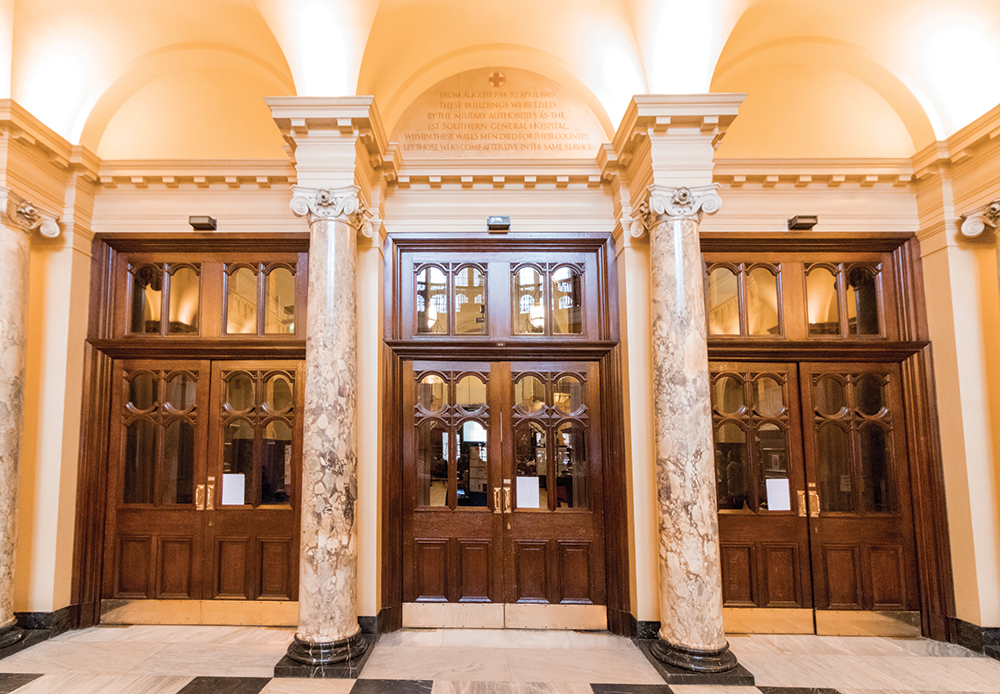
For anyone who has ever inspected or remediated a heritage door, this makes perfect sense. A Georgian six panel door does not behave like a modern door set, and its frame, substrate, ironmongery and glazing are often far more influential than the leaf itself.
Just as important is the standard’s shift to supporting evidence. Where old guidance leaned heavily on prescriptive construction rules, BS 8214:2026 now asks a much more meaningful question: “Can you demonstrate – with credible evidence – that this door, in this configuration, is likely to perform to the required standard?”
For heritage buildings, this is exactly the approach required. Many historic doors will never align neatly with modern factory tested configurations. But with the right methodology, they can often be sensitively upgraded to deliver acceptable – sometimes very strong – levels of fire and smoke resistance.
Historic England has long advocated minimal intervention, proportional upgrades and conservation led decision making in heritage settings.
Similarly, the IFE special interest group for heritage buildings stresses that original doors should remain in situ wherever safe and feasible, with structured assessments, smoke control improvements and context driven engineering judgements guiding decisions.
The LFB echoes this, particularly emphasising the need for clear documentation, understanding of concealed pathways and practical risk control strategies in older estates.
What all three bodies share is a belief that heritage doors deserve nuance, not a blunt “replace or fail” mindset.
This is precisely where a modern risk-based framework excels. Instead of asking whether an old door looks like a new one, we ask:
This is the kind of thinking industry regulators now expect – not least because it aligns better with the responsible person’s duties under the FSO, which explicitly require proportionate, risk driven control measures rather than rigid box ticking.
From my perspective at Golden Thread Fire Delay, this alignment is encouraging. Our entire approach – from detailed Type 2 heritage door assessments to full Golden Thread documentation – is built around:
Whether we are working with 18th century panelled doors, Victorian academic buildings, civic landmarks or historic healthcare estates, our objective is the same: understand first, intervene second. Where we recommend remediation, it is based on test evidence, approved repair techniques and explicitly documented reasoning. Where we recommend replacement, it is because risk and evidence demand it – not because a door is “old”.
This is exactly what the FSO requires, what ADB supports, and what BS 8214:2026 now codifies.
We are entering a period where the legal framework, the technical standards and the conservation bodies are finally aligned. And for organisations responsible for heritage buildings, this convergence offers something incredibly valuable: confidence.
Confidence that heritage doors can be evaluated fairly.
Confidence that sensitive upgrades are legitimate.
Confidence that evidence based decisions will stand up to audit or enforcement scrutiny.
Confidence that compliance does not have to mean compromise.
As someone deeply passionate about both fire safety and heritage, I believe this new landscape represents not just a regulatory update, but a cultural shift – one that values nuance, respects history, and still prioritises life safety above all else.
If you are navigating these questions across your estate, I’m always happy to discuss how a risk-based, heritage sensitive approach can support both compliance and conservation.
Because heritage doors aren’t obstacles – they’re assets. And with the right methodology, they can protect both people and history for generations to come.
