FIRE Magazine
Blue Sky Offices Shoreham
25 Cecil Pashley Way
Shoreham-by-Sea
West Sussex
BN43 5FF

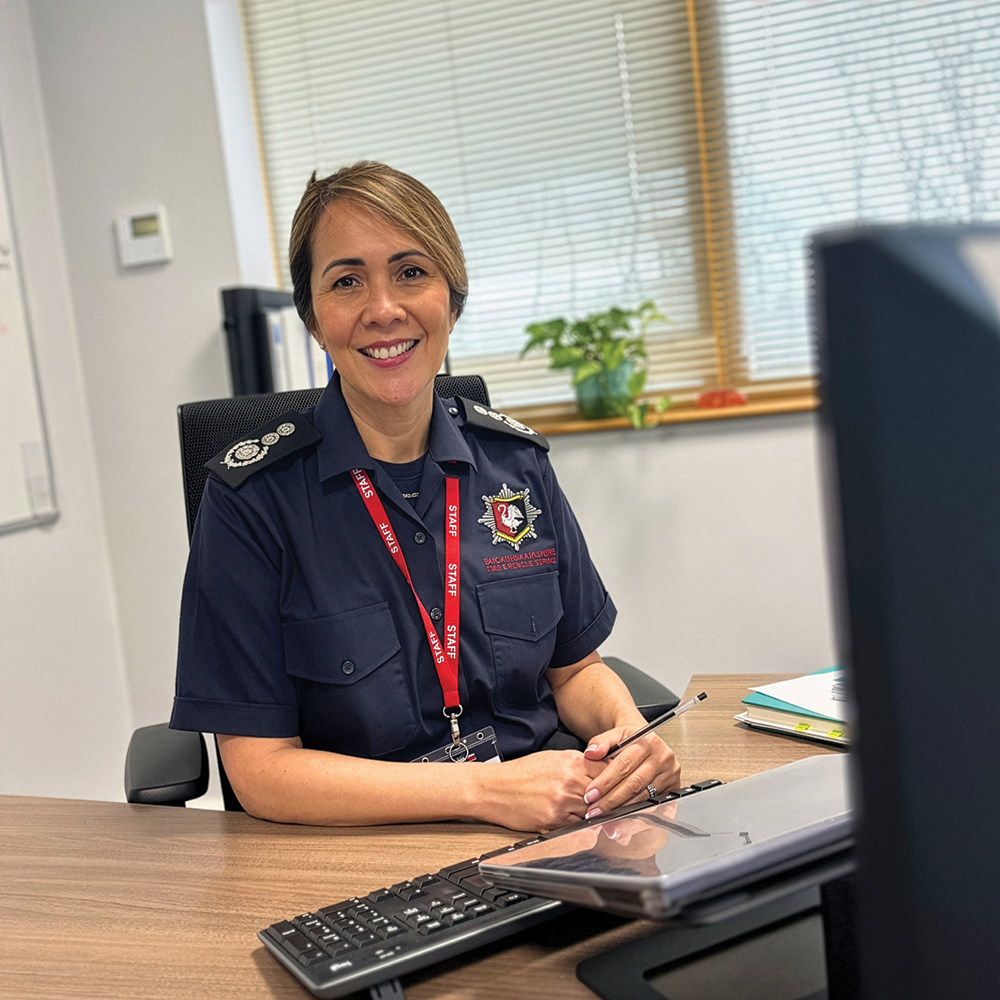
Louise Harrison is not one to shy from a challenge.
After arriving at Buckinghamshire Fire and Rescue as chief executive and CFO in December 2023, the Service had just been placed in special measures by HMICFRS – essentially it needed to improve. Quickly.
The judgement was withering: BFRS was not properly identifying people most at risk from fire; was relying too heavily on neighbouring fire and rescue services; and was lacking organisational nous when it came to identifying and managing risk.
And that was day one in her new role as CFO.
To make everything a tad more difficult, Harrison (by her own admission) had never even ridden in a fire engine, having spent the previous 31 years in the Merseyside Police and counter terrorism. Almost immediately this fact went online and the FBU challenged the decision asking if she was the right person for such a tough job.
Some three years on, Harrison has silenced her critics; BFRS exited special measures in March 2025. Much of that success is down to her hard work, mental agility and the team’s belief in her leadership.
“It’s true there was a lot of things to overcome,” Harrison recalled. “The story of my appointment even made local radio. Honestly, it was terrifying. I think you have to exude a certain amount of confidence, even if you’re not feeling it.
“We’d just been told our baby was ugly. We weren’t keeping people safe; we weren’t doing a very good job. And the eyes of the sector were on us”
“I was a woman, a non-firefighter, stepping into a bruised senior leadership team. I had to build trust in the team because they didn’t know who I was, although they knew I hadn’t been a firefighter.”
Harrison admitted that, like anyone, she wanted to be liked and did not want personality clashes to get in the way of the tough work ahead: “I don’t want the staff working at loggerheads with me. I want them to come along with me. So, yes, it was hard. But I’ve always been honest and open – I don’t know the technical stuff, I’m not going to pretend I always get it right, and I want you to challenge me. The only thing I’ve asked from everyone is openness and honesty.”
Harrison was starting a job where women comprise fewer than one in ten firefighters in England. In 2024, 9 per cent of the workforce were women – up from 1.7 per cent in 2002 – but still very much in a minority, according to HMICRS statistics. Nevertheless, while the Service remains a male-dominated environment, women such as Harrison are started to make a difference.
Ironically, because BFRS had been placed in special measures, the move gave Harrison the opportunity to take immediate action: “In a perverse way it was a gift. We’d just been told our baby was ugly. We weren’t keeping people safe; we weren’t doing a very good job. And the eyes of the sector were on us.”
During the first two weeks, Harrison had individual meetings with senior leaders, station commanders, protection teams, prevention teams and repeated the same questions:
what are you doing?
what is working?
what is frustrating you?
As a result, it soon became apparent the governance structures were not working: “We were making decisions at the wrong levels. There was no transparency. There was no follow-up process on many of the organisational decisions.”
Moreover, Harrison told the team BFRS needed to be leaner, more efficient and effective as organisation – while investing in key roles. After her discussions, she documented 200 priorities and made clear most of these could not be achieved any time soon.
“We needed to take the pressure out of the system,” she said. “What are we doing now that we don’t need to do? At this rate we were never going to achieve anything.”
Consequently, Harrison made a cull that she admits was ruthless: “You need to have a public sector heart, but a private sector mind. Behind the men and women going out the front door, we’ve got a business to run – and we weren’t very businesslike. We were heads down and couldn’t see the wood for the trees.”
This is where her policing background came in handy. Merseyside Police – one of the country’s largest and most scrutinised forces – gave Harrison a background in performance culture, accountability under pressure and in the kind of institutional self-honesty that comes from operating inside an organisation that is regularly challenged from outside.
Initial ideas included implementing a Clarity 4D-style indicator, a popular business tool. This is a personality framework analysing personality types based on how people think, make decisions, and interact with the world: “I needed a cohesive team and this is a really simple management tool that identifies who has a particular trait for being people-focused? Who is very dynamic and straightforward? Who are your movers? Who are your shakers? Who are the people that are going to win hearts and minds?”
It enabled Harrison to understand the makeup of the senior team and – importantly – how she would then get everyone on side.
“And now, because we’ve sorted our governance arrangements and just been a bit more structured in our systems and processes, it’s freed up capacity to do more – because we’re doing less of the stuff we didn’t really need to do.”
Two years on, the systems are more than in check. The causes for concern that placed BFRS in special measures have been formally closed by HMICFRS. A fourth round of inspection is underway, with a report expected this summer.
The question of whether a non-firefighter can lead a fire service has not totally disappeared. It is still there in the background, but evidence is clearly mounting that the answer is ‘yes’.
Harrison still understands the misgivings by some: “I imagine the idea of a senior fire officer coming in at a high level in policing would have police officers running for the hills – ‘what’s the world come to?’ But there comes a point in leadership where it’s about leadership and I think that’s what I’ve brought here.”
For the rank and file this means that each fire station now has a high degree of accountability and autonomy and continue to engage with the local community in the way they want to: “We’re a small service but we’re also going out now and delivering back to schools again. Each station now has a station plan and run their own fundraising, events, delivering prevention and safety to schools, which the schools love. It is brilliant.”
She describes the blue light hub in Milton Keynes – a shared facility with police and the South Central Ambulance Service – as symbolic of the multi-agency working she champions, something she finds genuinely energising about the role.
The service’s forward agenda is full: two station closures as part of a longer on-call improvement plan, a major refurbishment at High Wycombe station, and planning permission in place for a new county training centre.
Harrison’s is a classic leadership tale: the outsider brought in because they are an outsider, without the baggage that builds up over decades. The criticism of Harrison’s appointment failed to understand this fact.
Furthermore, the appointment of women to chief officer roles is happening more frequently than a decade ago. But Harrison is not the kind of person who dwells on being a symbol.
“I’m not arrogant enough to think I can just walk in and pick things up,” she said when she arrived. It was, in retrospect, both an honest admission and a statement of intent. She did not walk in and pick things up. She walked in, asked questions, made difficult decisions and turned a service around.
“The people here, honestly – they make it easy. They’re brilliant. They know their stuff. They’re very proud of this service and they want to do well by the communities because they all live in those communities.”
