FIRE Magazine
Blue Sky Offices Shoreham
25 Cecil Pashley Way
Shoreham-by-Sea
West Sussex
BN43 5FF

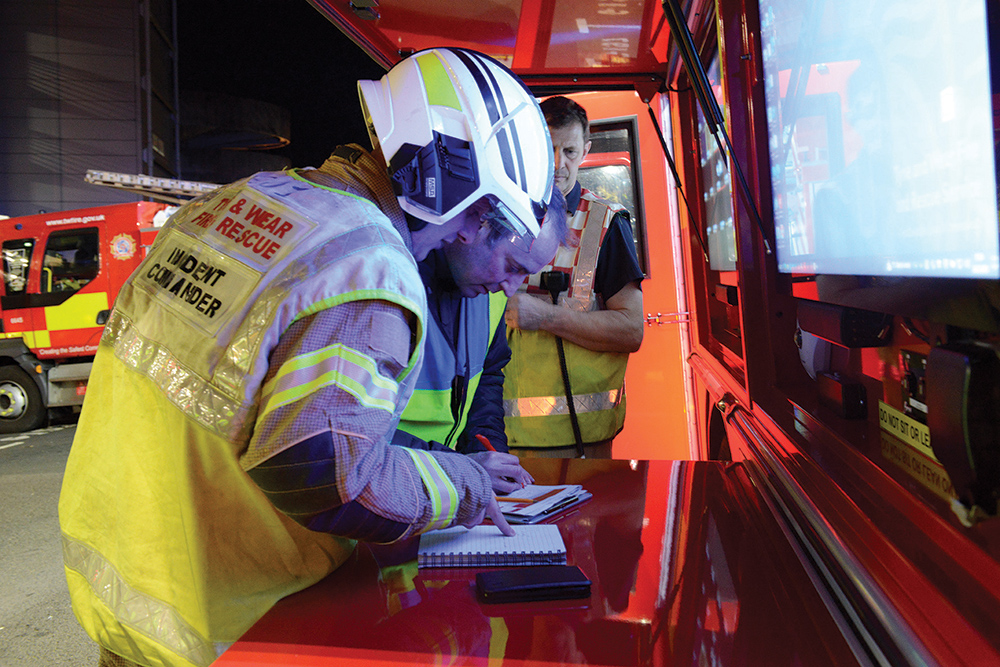
A large-scale terrorist attack may not be upper most in the minds of chiefs in the fire and rescue service, but the past decade has shown the threat remains very real – and one that the emergency services must be prepared to face.
Andy Lillford, who oversaw the planning and delivery of Exercise Cerberus in his role as area manager for operations and resilience at Tyne and Wear Fire and Rescue Service (TWFRS), said that during the past 10 years the focus has been on low-frequency, high-impact events: “Things like a terrorist attack in a large arena.”
To this end, the emergency services work closely with military partners and government agencies to monitor the threat of such events. “We share intelligence and look at what an incident might look like, should it occur on our footprint,” said Lillford, who also oversees operational national resilience capabilities as part of his role at the Northumbria local resilience forum (LRF).
Lillford added that under the Civil Contingencies Act, the LRF’s job is to ensure preparedness across the region for major incidents and emergencies such as flooding, severe weather and other issues that impact on the community: “One of the big risks, without being alarmist, is terrorism. Recent terrorist incidents in the UK have placed emergency services at the forefront of complex, high-impact responses. We need to be prepared.
“It is about preparing – particularly commanders – around what happens when the event occurs. We should not be making the rules up on the day, we should have all that ready. We should have tested, exercised and trained for what happens.”
To this end, it was decided to pull together a wide-ranging exercise involving all relevant emergency services and partner organisations in the Tyne and Wear area to assess the preparedness of services – and this became Exercise Cerberus.
Exercise Cerberus focused on Newcastle, although Lillford emphasised this was not based on any threat or intelligence: “The city of Newcastle is a very diverse, vibrant, multicultural city evolving all the time in terms of its economy, demographic, student population and sport.
“But you could say there is the sort of risk in our area of a large-scale incident that we need to test and exercise for.”
Commissioned by the LRF, the idea behind Exercise Cerberus was to bring multiple partners together and test specific components of a major incident response over a protracted period.
While TWFRS was the lead agency, Lillford emphasised that it was not a fire-specific exercise: “This was a partnership. Everything was done in collaboration. We’ve been training and exercising together with other services for years, but it was about bringing everything together and pushing boundaries and working in unconventional areas outside of organisational comfort zones.
“Essentially, we wanted to stress test our response to a major modern terrorist attack on our footprint. We drew on sector wide learning and formal recommendations that emerged following the Manchester Arena attack and overlaid that with a fictitious event within our area to stress test the preparedness and response capabilities of all responding agencies.”
“We then designed a marauding terrorist attack, which was a complex, multi-faceted attack scenario reflecting the kinds of threats seen in recent years.
“There were several focuses, including testing the real-time response to getting resources to the affected areas quickly and identifying things like rendezvous points for command and putting that command structure in early on the ground. It was also about the response from all the blue light agencies working together in synergy and about assertive command decisions between the emergency services to commit in the areas to save as many lives as possible, as quickly as possible.
“The exercise was built around a comprehensive multi-phase model to ensure maximum participation and impact for all agencies participating.”
Agencies involved included Northumbria Police, North East Ambulance Service, counterterrorism police, British Transport Police, County Durham and Darlington FRS, Cleveland Fire Brigade; wider NHS services including the integrated care board, NHS England, Newcastle Hospitals Trust and Newcastle City Council.
“Details, structure, planning meetings and risk assessments were carried out and key points of contact were identified within each service,” Lillford said. “We also had advice from subject matter experts from counterterror policing, national and local government and specialist advisors who have been involved in inquiries into previous terror incidents.”
This culminated in live roleplay, which included 300 volunteers who played members of the public caught up in the incident, to add extra realism to the exercise: “In addition to the volunteers, a local company used makeup and prosthetics to make volunteer victims’ injuries seem more real.”
When it came to the exercise itself, it was run as a real-life incident – right from first calls: “Activation was the initial priority. This involved the rapid standup of structures and activation of plans. It’s about the emergency services response to a marauding terrorist attack and how control rooms effectively share time critical information.
“Day one focused on predominantly control room response, which was basically 999 calls en masse, and the challenges posed by confusing information, including around locations and attack methodology.”
A major focus was on how control could filter out the most time-critical information from everything coming in and share that quickly with partners: “A lot of work has been done around interoperability. This was about establishing and applying JESIP [Joint Emergency Services Interoperability Protocol] quickly.”
Exercise Cerberus was run through as live: “We ran the exercise at midnight to lessen the impact on the wider community, but it was run in real-time.
“We brought everybody to the site. We had a command structure over the top and deployed life-saving actions, utilising recent training and learning, for example, 10 second triage. That was an important learning point from the Manchester Arena attack; all blue light responders in the Northeast now have training in 10 second triage.
“The realism of the exercise caught some people by surprise because when the first responders went through the door, they were confronted with a scene about as realistic as you could possibly get, with role players, background noise, a scene of chaos with hundreds of people appearing to be seriously injured. It was quite a demanding scene if you weren’t prepared for it.
“We achieved the number of strategic objectives of the exercise and then moved on the next phase, which was around strategic coordinating groups and tactical coordinating groups. Those are the mechanisms that allow command to start to plan and look forward.”
Another element that needed to be considered was communications and media management: “We use the term information battle, which is critical too in a major incident. We look at how we can enable comms teams. We’ve seen a lot of learning from other major incidents in recent years.
“Stress testing crisis messaging in real-time is a new area for the emergency services to navigate. What messages are we putting out to the public? How do we navigate media saturation and misinformation? We identified early in the planning the need to have comms officers embedded quickly within a tactical environment. They can offer specialist advice, using streamlined cue cards for rapid and accurate messaging. They can align public information strategies across boundaries and agencies.
“This is something that wasn’t really thought about up until recent years with the advent of widespread social media and of misinformation as well.
“People livestream now, so you’ve got to be mindful that this is going out globally in real time. That places huge pressures on providers and responders because basically the whole world is now looking at what you’re doing, and you’ll be judged on it.
“Communications was a core component of the exercise, acknowledging the vital role of public messaging and maintaining safety, trust and situational awareness during major incidents.”
Exercise Cerberus went far beyond just the initial response on the ground to a marauding terrorist attack, and explored what recovery afterwards would look like.
“We often talk around return to normality, but in situations like this you’ve got to accept that there will be a new normality,” Lillford said. “It’s about what does that new normal look like within communities?
“We looked at what the scene would be like plus 24 hours, plus 48 hours, plus one week, plus two weeks, plus a month, and then the anniversary. Various things were considered such as memorialisation, placing flowers at the scene, large gatherings and protests. Thankfully rare, but increasingly part of responsible emergency planning. We, as an emergency service, and LRF, must be aware of this when that happens and how we manage it and the sensitivities around it.
“This was multifaceted and we considered every effect the event might have on the region, from road closures to a small business being closed for several days. The ongoing effects are significant.”
Psychology and human factors also had to be taken into consideration: “We wanted a deeper insight into how organisations and communities cope with trauma and rebuild community resilience. This allowed agencies to explore how trauma, stress, and cognitive load might influence community decision making, organisational recovery, leadership and long-term resilience.
“What happens in the hours, days and weeks afterwards is also important as it puts pressure on the region. Generally, the emergency phase is over quickly. It’s the recovery phase that takes time.
“We’ve got to think about preservation of forensic opportunities, trauma support, welfare for staff who’ve been impacted by it and may be absent from work and the effect that has on operations. All these things, nobody really thought about years ago, people just got on with it. But we know now the impact on staff wellbeing is huge across the emergency services.
“In that immediate phase after an event we have debriefing, welfare signposting and resource issues – as well as the usual day-to-day business. We still go to road traffic collisions and fires, police will still respond to crime and the ambulance service will still be dealing with health emergencies. It can be quite a stressful environment.”
Organising such an exercise takes time and effort. Lillford estimates it took 12 months from initial plans and meetings to the execution of the exercise: “It was hugely resource intensive, with more than 30 organisations involved.
Getting all the organisations involved to buy into the exercise was crucial. To do this required building relationships and trust: “A lot of it was done face to face. We had regular planning meetings, so key members from each agency were in regular contact. The workload was spread around, but we had strategic oversight of it. It was very much a partnership approach.”
In all, the exercise had 700 participants, including 300 volunteers, and more than 30 organisations involved: “With those numbers, the coordination and planning element was critical. It’s a credit to all the professional networks that were built up and the professionalism, dedication and cooperative strength of the Northeast’s emergency response. It stands as a fine example of the effect of collaboration and partnership and demonstrates how unified public services can enhance community safety, improve readiness for major incidents, and set new standards of public sector excellence.”
Importantly, the exercise helped to bring the various organisations closer together. While they may converse between each other in the normal course of duty or coordinate on campaigns, they seldom have the opportunity to be in the same room.
“Once the operational side had taken place, then the learning from that was then fed into the comms day. For us as an organisation to be able to be in the same room as all the other organisations from the universities through to the NHS, and local authorities and share the learning was crucial to how we move forward.”
Lillford said the learning has also been cross-boundary “We have identified areas to improve, where resources need to be focused, either in single agencies or jointly, to ensure we are fully prepared for a multi-agency, multi-sided event that might impact the region.
“It was very much pan-region. We reached out across the Northumbria border in the Durham and Cleveland areas, because we’ve recognised outside of the large metropolitan areas like London, Manchester and the West Midlands an incident of this scale almost certainly would draw in mutual aid from other parts of the country – something we test and prepare for. Whether that’s through the health trauma networks, the hospital networks, armed policing, fire and rescue specialist assets, recovery, disaster victim identification or rest centres.
“Going forward, we’re taking the learning from it, and we’ve set the blueprint for what that collaboration and excellence looks like, and we’re keen to look at how we evolve this into a smaller, more routine exercise and based around threat, risk and interoperability. This will be constantly updates as new learning comes in too.
“While incidents of this nature remain highly unlikely, Exercise Cerberus demonstrates the commitment of Tyne and Wear Fire and Rescue Service and its partners to ensuring the public can go about their lives with confidence, knowing that emergency services are trained, tested and ready to respond together should the unthinkable ever occur.”
