FIRE Magazine
Blue Sky Offices Shoreham
25 Cecil Pashley Way
Shoreham-by-Sea
West Sussex
BN43 5FF

Around 200 post-crash professionals attended Brake’s After the Crash conference in Manchester on Thursday 11 June.
Among the attendees were members of the police force and emergency services, law firm representatives, corporate partners, bereaved campaigners, road victim supporters, and others who work in the road safety and post-crash care sector.
Opening the morning’s programme, Deputy Mayor for Greater Manchester Kate Green talked about moving closer to Vision Zero, following last year’s launch of the £1million Vision Zero Innovation Fund aimed at eliminating traffic fatalities and life-changing injuries in the region by 2040.
She highlighted that around 10,000 people have been killed or seriously injured on Manchester’s roads in the last decade, adding: “There is no number bigger than zero that we will tolerate.”
She finished her introduction with a tribute to the emergency services who support “brave and inspiring” families after a collision and who “make a time of unimaginable horror a bit easier”.
Addressing delegates by video, Claire Waxman OBE, Victims’ Commissioner for England and Wales, spoke of the “epidemic of trauma” caused by road collisions and the “fragmented, confusing system” that victims are left to navigate.
“Despite the staggering scale of harm they experience, [road victims] are still too often strategically overlooked [and] do not receive the same recognition or parity of rights as victims of other serious crimes,” she said.
“Support is not an optional extra or a luxury add-on. It is foundational to recovery. Excellence in post-crash care must become the standard, not the exception,” she added.
The findings from the commissioner’s research into road victims’ experiences will be published later this year, she said.
“Road victims are not second-class victims, but they are too often treated that way”
Next, Brake CEO Ross Moorlock, gave a stirring account of the current landscape for road victim support and how Brake’s National Road Victim Service has evolved to meet the demand for tailored, expert support despite receiving no central government funding across England and Wales. Ross highlighted that the charity had supported more than 3,200 people in 2025, while 35 local caseworkers – embedded across England, Wales, and Scotland – are currently supporting more than 1,000 families.
“Over the last five years, we’ve built teams, expertise, and confidence in what good looks like,” said Ross. “We’ve challenged ourselves, each other and the wider system. We’ve raised expectations. We’ve pushed standards. We’ve got road victim support onto agendas where previously it simply wasn’t.
“We are not where we need to be. There are still families struggling to access support, and we still have differences in support provision in different part of the country. [But] we are absolutely committed to continuing that fight, on behalf of every family who needs support in such difficult circumstances.
“We will keep pushing for stronger prevention. But we will also keep saying: post-crash care matters, victim support matters, and it must be properly recognised and funded. We will keep building, we will keep growing. And we will keep fighting for every family affected by road harm.”
The impact of support on victims’ experiences
 The next segment of the programme focused on real-life examples of the true impact that the right support – individualised and shaped around each person’s unique needs – can have on individuals after a road death.
First, Brake’s partnerships manager Imogen Grylls sat with Nicola Bell-Percy, whose son Aaron, aged 18, as well as two of his friends, died in a crash in July 2022. The driver, also 18, was later convicted of causing death by dangerous driving.
Nicola spoke to Imogen about the support she received from Brake. Her experience underlined that the tailored, expert support which the charity provides was pivotal in helping her to get through the most challenging times.
When asked by Imogen what good support looks like, Nicola replied: “Everyone is different. For me, it wasn’t about someone trying to fix me. It’s the simple things, like having face-to-face support, seeing someone across the kitchen table, having a coffee, not being judged. The caseworkers reassured you that however you feel, it’s normal. That was a huge, huge help.”
As well as emotional support, Nicola’s caseworker, Don, guided her through the justice system and helped with practical things like liaising with her younger son’s school. He even took the hoodie Aaron was wearing on the day of the crash and had it cleaned before returning it to Nicola – a true testament to the extra mile Brake’s caseworkers often go in supporting their families.
Next, Ciarán O’Meara, senior triage caseworker at Brake, presented a compelling case that demonstrated how different intersecting experiences affect the way a bereaved person engages with professionals, and the importance of specialised support services.
Ciarán supported ‘Sarah’ after her mother was killed in a crash. Estranged from other family members, Sarah had suffered terrible abuse throughout her life and a violent marriage. These events had remained unprocessed for many years and impacted how she grieved the death of her mother, with whom she’d had a difficult relationship.
Highlighting the range of ways that Brake caseworkers support road victims, Ciarán described the process of stabilisation he helped Sarah through, leading her to engage with other support agencies and fulfil some of the goals she set herself.
Delegates then watched a Victims’ Voices film, in which Sammi Cousin opened up about the death of her son, Rhys, daughter-in-law, Gemma, and two infant granddaughters, Peyton and Heidi, in a crash in the Scottish Highlands in 2020. Sammi received post-crash support from Brake.
Panel session: From crash to career
The morning finished with Dr Ian Greenwood chairing a panel exploring how lived experience of road crashes shapes a career in road safety. After a crash that caused the death of his daughter Alice, who is “forever 12”, Ian segued from a top job in the NHS to road safety research, including a PhD on the politics of road death which Ian described as “an itch I had to scratch”.
Opening up publicly for the first time about his own experience, Brake CEO Ross Moorlock told delegates how a cycling collision 16 years ago – which left him with serious injuries and a lasting psychological imprint – led him to a job at Brake. “It felt right and I haven’t looked back,” he said.
Next, George Henry, Head of Road Policy and Safety at Transport Scotland brought some humour to a heavy topic, sharing photos from his teenage years as he talked about crashing his car on a rural road in a heavy downpour when he was just 17. George sustained injuries to his spinal cord and has been a wheelchair user ever since the incident in November 1996. He adjusted to his new reality and has enjoyed a 20-year career in road safety. Of his current role, George said: “Every day, I try to make a difference.”
The final panel member, Debbie Mullan from Road Victim Support Northern Ireland and Donegal, told delegates about her 17-year-old son Keelan, who was killed when he crashed into a tractor weeks after passing his driving test. Debbie was training as a counsellor at the time and rerouted her career to support families bereaved by road death. “I never knew I was strong or resilient. If I can keep getting up and moving forward, I can help,” Debbie said.
Case investigation and support for children
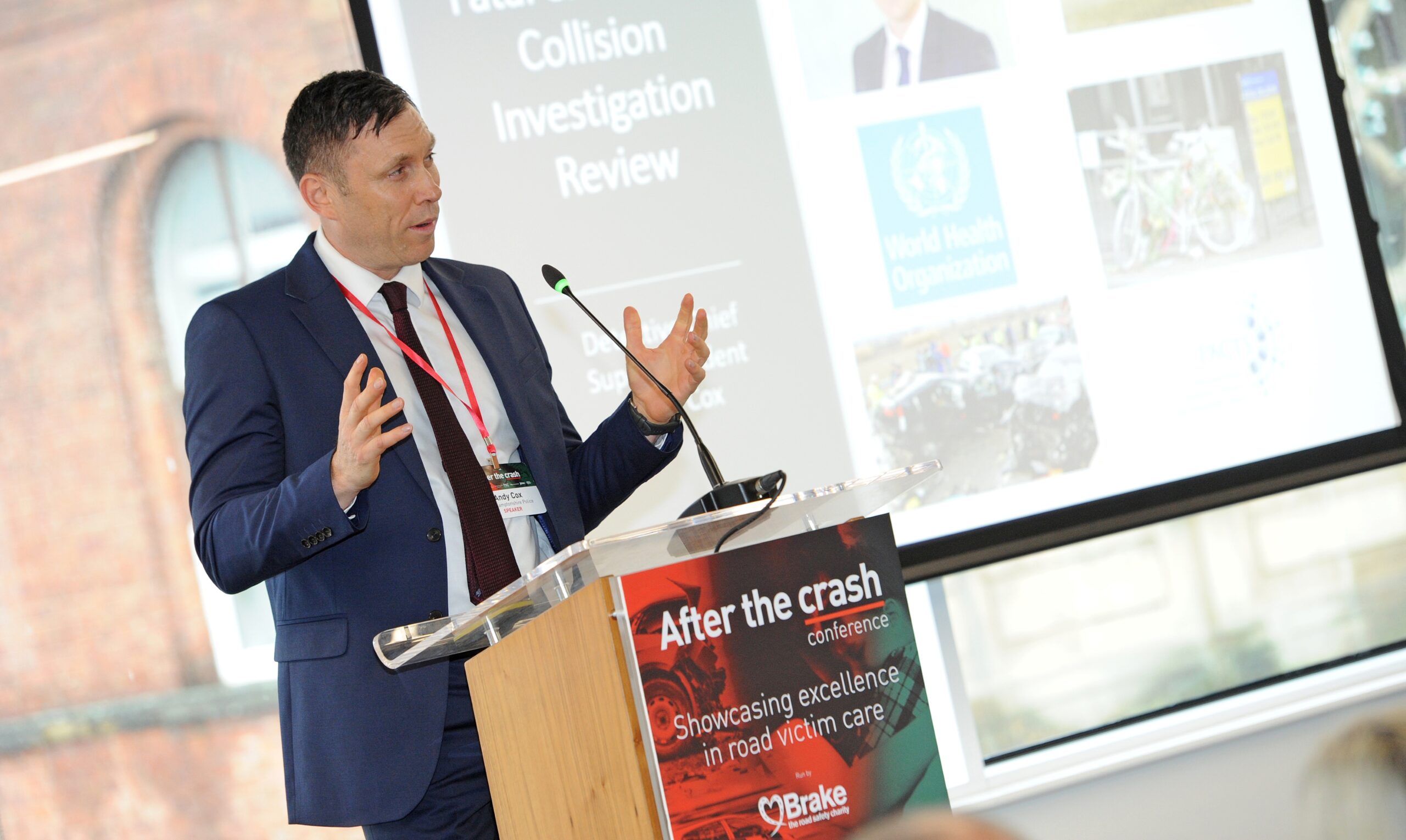
Kicking off the afternoon was Detective Chief Superintendent Andy Cox, Head of Crime at Northamptonshire Police. In his keynote speech, he summarised a review of the force’s investigations into fatal and serious collisions, which led to an increased focus on crash prevention, proper scrutiny and governance, and improved support for crash victims and families.
Next, Brake caseworker Gary Harker presented a case study of the support he provided for three families after a multi-fatality incident. His case once again showcased that different approaches are required for different people, whose experiences may be broadly similar, but whose complex individual needs mean support must be flexible and tailored.
Gary noted: “[This] highly complex case demonstrates the level of sustained, victim-centred support Brake can provide in exceptional circumstances. This is not representative of every case, but it illustrates how support can adapt when family needs are prolonged, complex, and changing over time.”
Another case study followed, this time presented by Detective Constable Bruce White from the Serious Collision Investigation Unit at the Metropolitan Police. He talked about the challenges he faced investigating the death of a female cyclist who was killed by a someone driving recklessly and at speed in Hackney, east London. After the successful prosecution of the driver, the cyclist’s family reported that they benefited greatly from the regular, post-crash contact from Bruce. He also noted that information shared with families in the immediate aftermath of a fatal crash should be kept minimal and basic, because people’s ability to absorb what you tell them is severely impaired by their shock.
Panel session: children’s needs
Professor Sarah Jones, Consultant in Environmental Public Health at Public Health Wales, chaired an insightful afternoon panel session on supporting children and young people.
Detective Inspector Tim Evans from the North Wales Police Serious Collision Investigation Unit talked about the support needs of a young girl who was injured in a crash that killed her cousin and uncle.
The audience listened as Letizia Perna, Director of Services and Service Transformation at Child Bereavement UK, gave her top tips for talking to children and young people about road death: speak plainly in clear and honest language; don’t assume a level of understanding based on a child’s age; and think beyond the first conversation.
Jo Birch, national service delivery lead at Brake, explored the role adults play in supporting children and young people affected by fatal collisions. Acknowledging that bereaved adults try to protect children from their grief and feel pressure to have all the answers, Jo pointed to Brake’s children’s resources as useful tools to help adults to support children.
From September 2026, every school in England must include death, grief and bereavement as part of the curriculum. The panel welcomed this move but remarked that it must be delivered by appropriately trained and experienced people.
Together, the panellists also discussed creative ways of empowering children in their grief and sadness. They mentioned memory boxes, memory bracelets, journaling, and painting items of remembrance.
The final presentation of the afternoon was given by Hannah Bailey from Blue Light Wellbeing. Hannah, a former police officer who now works as a therapist, mainly supporting police officers and military personnel, talked about the impact of moral injury among post-crash care professionals. She highlighted that people affected by moral injury have a high risk of suicide and are unlikely to seek help from within their organisation.
Hannah’s take-home message for employers and leaders was to help teams find value and understanding in their roles, to highlight “small wins”, and to show individuals they are valued, especially if they are on sick leave, restricted or under investigation.
For support professionals themselves, Hannah advised engaging in hobbies and activities unrelated to and outside of the workplace, and considering seeking support elsewhere, through culturally aware therapists, charities or police chaplaincy.
That led nicely to a closing address of the event, given by National Police Chaplain Reverend Matthew Hopley. He led the room in a moment of silent reflection in acknowledgement of the collective experiences of the conference attendees, and a poignant tribute to those killed and injured in road crashes whose stories were shared throughout the day.
The conference was expertly hosted by Dan Campsall, chairman of Agilysis, chair of the UK’s Parliamentary Advisory Council for Transport Safety, who picked up on common threads across the day and kept the packed and varied programme moving at pace. Reflecting on LinkedIn after the event, Dan said: “Today, I had the privilege of hosting Brake, the road safety charity’s hugely important ‘After the Crash’ conference, bringing together many of the absolute heroes who inhabit the darkest of times, supporting the victims of traumatic road injury and the bereaved who are left behind. My heart is heavy as I head home, reflecting on a poignant day that juxtaposed the worst of personal tragedy with the best of human kindness… I am immensely proud that I work alongside such deeply committed people.”
After the Crash 2026 was organised by Brake and sponsored by Alderstone Solicitors, Hodge Jones & Allen, HCC Solicitors, Irwin Mitchell, JMW Solicitors and Slater and Gordon Lawyers UK.
